25.01-25.05/2026, Paul Cezanne (1839-1906), Beyeler Foundation, Basel, Switzerland
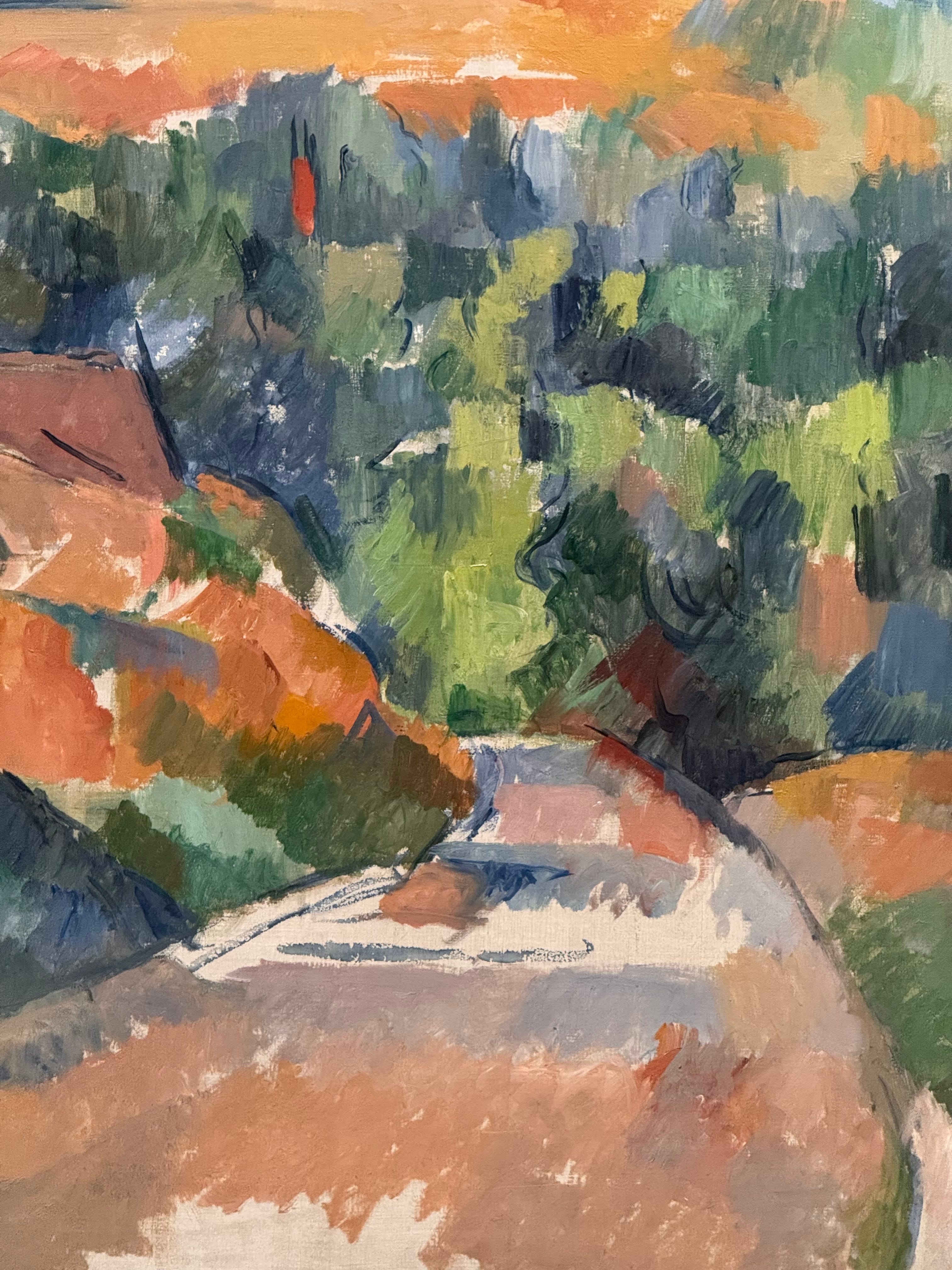
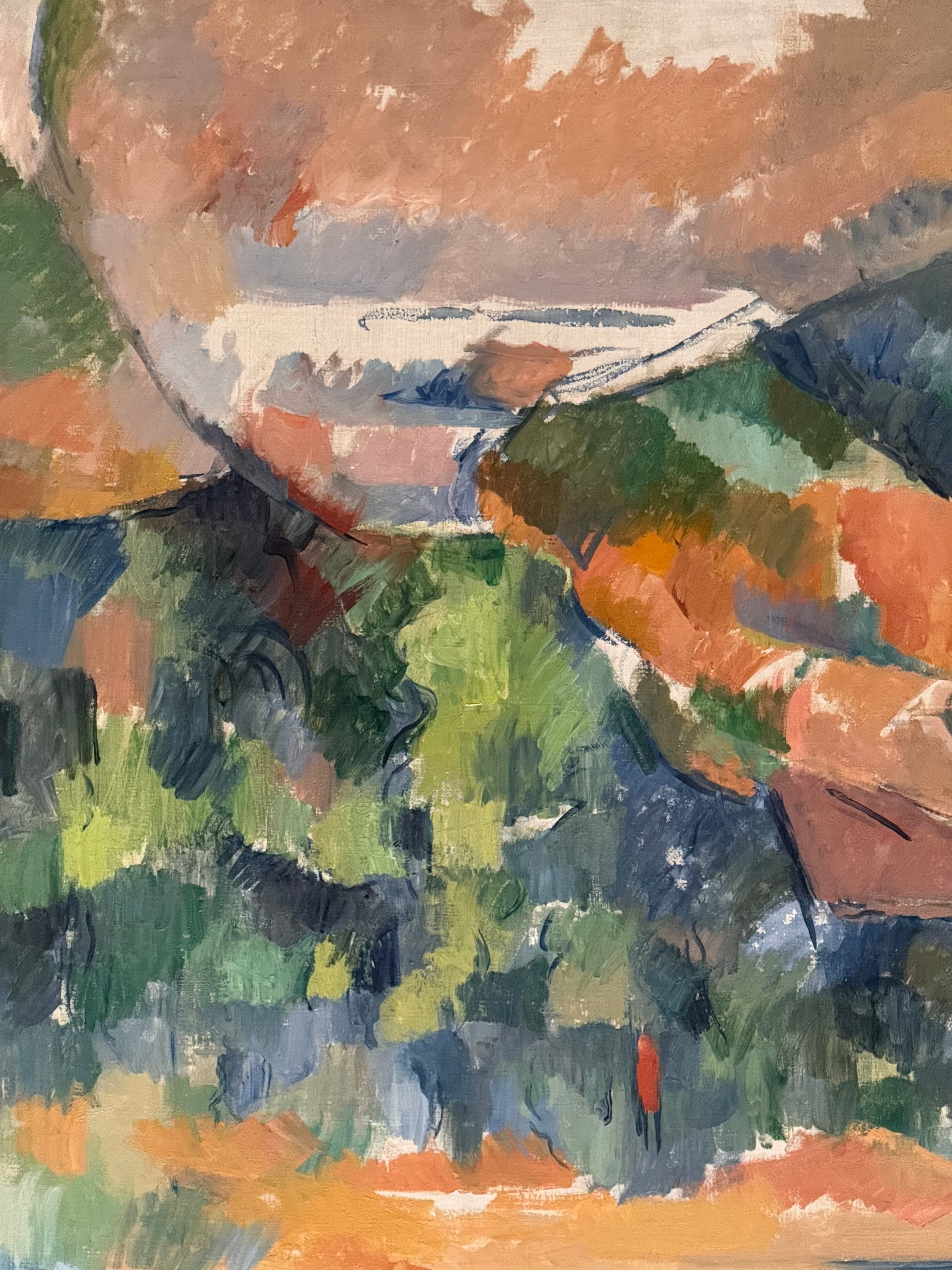
Left, PAUL CEZANNE, LA ROUTE TOURNANTE (MATINÉE DE PRINTEMPS À SAINT-ANTONIN), (BEND IN THE ROAD (SPRING MORNING IN SAINT-ANTONIN)), 1900–1906 Oil on canvas, 82.1 x 66 cm, National Gallery of Art, Washington, DC, collection of Mr. and Mrs. Paul Mellon, 1985. Right, PAUL CEZANNE, LA MONTAGNE SAINTE-VICTOIRE VUE DES LAUVES (MONTAGNE SAINTE-VICTOIRE SEEN FROM LES LAUVES), UM 1904 Oil on canvas, 54 x 65 cm, Private collection, Derbyshire Photo: Christie’s Images / Bridgeman Images. All rights reserved.
Do not miss this exhibit! This is the first Cezanne show organized by the Beyeler, although he is one of the most important artists in the museum’s collection. The focus, says the Beyeler, is on the “last and most significant phase” of his painting career, 80 paintings and watercolours, that “bring to life Cezanne’s groundbreaking work as regards form, light and colour.” A note if you’re considering a visit, the museum’s layout and organisation of the show allow you to view the paintings without feeling crowded. It is beautifully curated and the building designed by Renzo Piano, which sits in a park, is a fine contemporary cradle for work like this from earlier periods.
Allow half a day and don’t forget to pause and look out the windows at the nearby vineyards; Basel has limited Swiss wine, but what it has is very good. You can also take advantage of a little workshop area to do some painting yourself - the day I was there it was buzzing with old and young artists picking up tips from the staff.
For a writer, the whites in Cezanne’s paintings in the Basel exhibit are a lesson in what a story should include or leave out, and how the visual arts can guide artists who are working in other forms.
Two new pairs of spectacles, one tortoise framed, the other with wire, were delivered by the Swiss post Friday. Saturday he put them away. Sunday he couldn’t find them. Monday he said to hell with it I have the tickets I’m going anyway.
At eleven he stepped into his jacket, the one he wore for this annual cultural visit; it rendered him visible for a change. The Green Basel tram pulled up just as he arrived at the stop; he was pleased that the conductor spotted him.
At noon, standing in an open space at the Beyeler he studied The Gardener Vallier, all versions, last was best. By one he asked (not aloud) why The Bathers were all nude but one, who wore white underpants, same design as his own. By two he was in love with the The Bend in the Road. At two-ten he was still there, trying to see why you knew the road went down, not up. By two-fifteen the road was going up.
Portion of La Route Tournante, Paul Cezanne, 1900-1906, my personal photo (may not be reproduced)
He leaned in close. The boys in black didn’t stop him but they drifted nearer. Vertical appley greens brushed, darker greens brushed, greens with blues and blues with - rust. Rust. And white. Closer yet, a shame about the spectacles (and even the old monocle! why had he not thought of that?) left at home. Blue verging on gray - holy smokes, there’s no paint dabbed there, just canvas! No paint?
Easy enough to settle the road question first, just look at it upside down.
No touching the canvas, of course, so he did a handstand and held it. His balance was flawless.
With apologies to Monsieur Cezanne (may not be reproduced)
“Sir? Please be upright.” There was a nervous edge to the voice.
Thus spoke the burghers of Basel, he said (not aloud). He inverted himself and the boys in black relaxed. He was grateful they’d noticed him.
By two-thirty he was alone with his secret discovery and happy. He caught the tram to the city centre. He sat immobile, unmoving but not unmoved. Babies strollered in pink, trees grew on brown trunks, doors opened and closed to the rhythm of green and red lights, a cumulus cloud punctuated a blue sky.
Cezanne was a seer! It wasn’t a winding road at all! It was a clown playing a violin, wearing a green tie, and a small human in a red jacket was listening carefully. The song was The Long and Winding Road. Cezanne was a seer!
Carnaval drums throbbed through the streets, reverberating through the green tram. It came to a halt for the parade. Donald Trump and the gods of war marched past, grimacing and larger than life and every few minutes falling down, then a sign about Pride would pop up, and he laughed, aloud, having prepared for Carnaval’s themes this year. A giant clown wearing a long green tie marched past, playing a violin, and a small, empty red jacket marched alongside. He hopped down from the tram and in one stroke he stepped into the red jacket, for he’d left his own at the Beyeler. Every year he left it somewhere and every year it reappeared in the parade. Carnaval had another few hours to go and when it was over he would fade away, as he did each year, had done every year for more than a century now. Every year another artist taught him something new and then he marched in the parade and he saw what the burghers of Basel were mocking, and those were two methods for getting up to snuff about the ways of the world.
Cezanne was a seer! He was a genius at hiding things with his brush strokes, including art from the future. Humans were geniuses at understanding that pride goes before a fall, Donald (he said aloud) - and at understanding great art, Paul!
2026 was worth the visit.
Holy smokes!
Paul Cezanne, when I first met him long ago, impressed but failed to charm me. Impressionists - with whom he painted and in a few instances exhibited - were easier to understand, bright colours and scenes that made sense. Even now, I can slip into his world most easily if I start with a painting like The Gardener, where I spot a hat and feet and a man surrounded by plants and tools. Or The Card Players, with their decks and felt hats. My storyteller’s mind can conjure up tales from these details.
Slowly, over the years and thanks to exhibits like the 2024 Gianadda show, Croisés Cézanne-Renoir, (the Beyeler drops the accent in his name, as the artist himself did) I came to see his bold, strong paintings as a rich source of inspiration.
Cezanne's bold brush strokes (paintings from the 2024 Gianadda Cezanne-Renoir exhibit)
Writers must read, to learn their craft and stretch their artistic muscle, but they also need to learn to dance on their toes and sing in another register and settle down surrounded by what writer Camilla Grudova calls the furniture of life - for this, we need to learn from the other arts. Some writers turn to music, but many of us go first to the visual arts for prompts. I photograph incessantly for this reason. You don’t need to call yourself an artist to do this. Art, when we pay attention to it, obliges all of us reconsider life, the whole shebang or one shard of it at a time.
Before I move on to the things that are missing - the “un"-”, the negative - that Cezanne experimented with in his later works, here is a reminder from the Beyeler exhibit: he played a significant role as a bridge between the Impressionists and Modernists, especially Cubists. Brush strokes made him famous, revered by other artists like Picasso, who called Cezanne “the father of us all.”
Normally I let myself float away on Cezanne’s colour schemes (those greens and russets and port wine red and oh, the celestial blues that are brought to Earth!). Flowing with the small crowd the second day of the Basel show, I came to La Route Tournante (The Bend in the Road). Had he missed a spot? Unlikely. Where are the daubs of paint, or several, and the famous linear vertical strokes, at this point where the road is white? I don’t recall ever seeing a painting of his like this.
Later, I find an article by Harry Cooper in ArtForum magazine about an important 2000 show in Vienna and at the Kuntshaus in Zurich, “Cézanne - Unfinished, Finished”:
By the time of his death in 1906, the most important color on his palette was bare canvas or (in the watercolors) bare paper, an unmark that made the marks around it shiver into life.
With Cézanne ‘a form exists only by virtue of the neighboring forms,’ R.P. Rivière and J.F. Schnerb noted in 1907. Corollary: A blank can be a form. This demonstration of the equal semiotic rights of unworked, unmarked areas made everything possible in modern art, from Pollock’s use of bare canvas to Cage’s manipulation of silence to perhaps even Duchamp’s readymades.
Cooper goes on to say that while Cezanne’s oeuvre is scattered with unfinished works, “It is difficult to see them as anything other than finished masterworks containing the history of twentieth-century art in embryo.” As the artist became more financially independent, with less pressure to complete and thus sell canvases, the more works we find that are incomplete or that have unpainted areas.
His words, written 26 years ago, found their echo for me this week in a Granta Magazine writers’ workshop I’m taking part in. We read an excerpt, “Stillness”, from American fiction writer and essayist Charles Baxter, from his collection Burning Down the House. The essay focuses on the often overlooked role of silence "and its parent”, stillness, in fiction.
I’m all ears for Baxter’s writing wisdom - I’ve written one-third of a trilogy, an action-packed historic crime novella with a main character who is mute.
We often think of silence as being a blank, a null set, or of all silences being similar, expressing the same thing, the same nothing. We may not actually need John Cage, however, to show us that silence is an intensifier - that it strengthens whatever stands on either side of it. Directed in this way, silence takes on a different emotion, a different colour, for whatever it flows through or flows between.
According to the art dealer Walter Feilchenfeldt, these ‘unfinished’ works were considered to be of inferior quality until the post-war period but had already been held in high esteem by Matisse and Picasso. In 2000, the Kunsthaus devoted a wide-ranging exhibition to the question of finishing the work in the case of Cézanne. When is a work intentionally, when accidentally unfinished?
Silence in fiction, unmarked areas in paintings: I turn back to Cezanne in Basel to lean close into his unpainted whiteness, considered inferior when his brushes skipped over part of the canvas, but now considered non-strokes of genius. At the same time, I hear in my head Ben Lerner reading his story “The Polish Rider” for a New Yorker podcast, about an unfinished version of the famous Rembrandt painting, and the comment of one of my fellow workshop writers “about how writing can interact with other art mediums.”
Cooper, in ArtForum, points out that it’s hopeless to try to understand Cezanne’s attitude towards finishing or leaving blank spaces.
The juxtaposition of two late sous-bois pictures (each showing a road bending beneath trees) brings the question home. In Forest Path, 1900–02, a tissue of blanks allows the picture to breathe as if through pores; in Bend in the Forest Road, 1902–06, on the other hand, everything is magisterially sealed.
The sous-bois, or forest underbrush paintings in the Basel show were among my favourites. Comparing them gives us a deeper sense of the artist at work, questioning what he is doing, how well it works, when it is finished, or if there is or should be such a moment. For writers, who struggle to know how much to add, what length is just right for a given story, or where to cut, seeing Cezanne at work is heartening. Writers don’t write into a void: we hope to connect with readers, who must participate in a story. Cezanne showed us the way. From the Beyeler catalog:
The exhibition attempts to show how Cezanne made visible the structures of his pictures, thereby inviting viewers to engage with and participate in his painting process. This is especially true of the works that appear unfinished, in which the artist took the liberty of leaving parts of the canvas unpainted, achieving a new form of harmony. These compositions are characterized by a kind of open-endedness, allowing the engaged viewer to mentally continue and complete them in their imagination.
A final note, which veers away a bit from the Cezanne show. Given the warlike activities of the past few days, essayist Charles Baxter’s words on Americans and stillness are haunting my thoughts. He’s talking about Mark Twain’s Huck Finn, that all-American masterpiece character, when he refers to “something of a rhapsody, [a] beautiful sentence in his book, and, I think, one of the most beautiful sentences in American literature.
Near the beginning of chapter nineteen of Adventures of Huckleberry Finn, the sentence is therefore in close proximity to the death, by gunshot, of Huck’s friend Buck Grangerford in chapter eighteen, and the death, also by gunshot, of Boggs, by Colonel Sherburn, in chapter twenty-one.
It is as if Americans typically have their moments of stillness when those moments are framed on both sides by violence. It is a peculiarly American form of Zen enlightenment, when stillness can only justify itself by planting itself amid uproar.
“All kings is mostly rapscallions, as fur as I can make out,” said Huck.
Twain also wrote The War Prayer, in 1904-05, a satire on American imperialism that bears reading again.




Did you know that the exclamation holy smokes! Is from the mid to late 19th century? Who knows - it might’ve been Cezanne’s favourite English phrase.